RC Baja Car Drivetrain & Chassis
Testing
The testing plan for the RC Baja Car aims to verify compliance with the specified requirements in section 1.d. of the proposal/guide. Four key tests will be made in order to very completion of these requirements. Acceleration, jump/drop, crash, and dimension/weight testing have all been designed to address major performance criteria. The team expects to meet or exceed requirements based on thorough analysis and design considerations.
The acceleration test focuses on reaching 15mph within 5 seconds, with predictions based on motor power output and gear ratios. Jump/drop testing involves a 4-foot drop and a 10mph jump from a wooden ramp, surpassing the 10lb load requirement. The team is confident as the vehicle has surpassed analysis for the four-foot drop. Crash testing, at a minimum speed of 22.5mph, assesses structural integrity, particularly the bumper and front differential cover. Dimension and weight testing involve measuring proportions and ensuring the vehicle meets the 10lb weight limit.
A systematic approach will be applied, with each test being repeated five times and results analyzed for potential improvements. Adjustments, such as changing gear ratios during acceleration testing, will be made as needed. Additional testing will be conducted in case of component failure or if further changes are required. The overall strategy is to ensure rigorous testing, reliable data is gathered, and to make informed adjustments for optimal RC Baja Car performance.
During Testing there where no specific problems with the testing procedure or process its self but the post testing analysis showed signs of issues. Specifically determining the proper young modulus value of each test sample was difficult, especially for the composites. When determining a young modulus value for a composite the equation requires the specific volume of each substance taking into account the young modulus for each, it was difficult to measure and pour an exact amount of each material in grams which could in turn skew the results. Along with weighing the carbon samples, as there are air pockets in the larger chucks which can affect the weight and presumed volume of the carbon fibers this can also skew the calculated results. As this was very time consuming to determine the volume of 65D to carbon fiber along with then working through composite young’s modulus equations and values to rework through the rearranged deflection equation this took much more time than predicted which was per say the only real issue associated with testing.

Testing 01 - Material Testing
This test is used to determin if 65D thermoset plastic is a viable material for the RC Baja car. In order to do so the material properties must be found, specifically the young's modulus (E). This test coincides with the dimensional requirements within the ASTM standard D638. Utilizing molds, test samples (shown in Image 4.1 on the left), and The Instron Machine (The data collected below in Image 4.2). The following data describes the test results with Stress over Strain. After analysis was done using the 417psi found for the 65D material it determined this was far too low of a young's modulus to utilize this material within the chassis.
Image 4.1 - Test Samples

Image 4.2 - Test Data
Testing 02 - Chassis Deflection Testing
The second test conducted was the chassis deflection test. This is used to determine whether or not the chassis can resist a load of at least 18lbs with less than 5/16-inch deflection. During the five trials the chassis deflected 1/8-inch with greater than 250lbs of load. This is just shy of 14 times the required load and less than half the required deflection. Utilizing an extra 3D printed chassis along with the Instron Machine depicted to the right in Image 4.3.

Image 4.3 - Chassis Deflection Test on Instron

Image 4.4 - Acceleration Testing
Testing 03 - Acceleration Speed Testing
The third test was used to determine if the vehicle could reach speeds of 15 mph within 5 seconds. This test, which involved five trials showed that the RC Baja Car was capable of reaching 18 mph in 5 seconds. Thus, surpassing the required speed. During testing the pinion gear on the motor was changed out to increase the gear ratio. This in turn allowed the vehicle to reach speeds of 20 mph in 5 seconds. Images from testing can be found on the left in Image 4.4.
Testing 04 & 05 - Dimension and Weight Testing
The fourth and fifth test are as simple as they seem. As two requirements for the RC Baja Car require the car to be no longer than 24 inches in length. This can be found in Image 4.5 on the right. The RC Baja car surpassed this requirement by 6 inches.
The RC Baja Car chassis and drivetrain must weigh less than 10 lbs. This can be found in Image 4.6 below. The RC Baja Car surpassed this requirement by 3 lbs. Weighing in at just over 7 lbs total rather than the chassis alone.

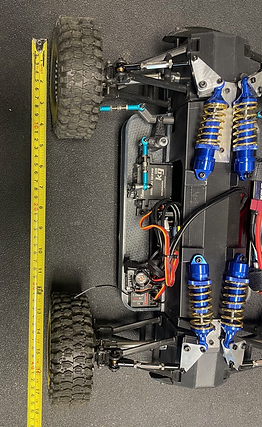
Image 4.5 - Dimension Testing
Image 4.6 - WeightTesting
Video 4.1 - Testing Compilation Video
Video 4.1 depicted above and to the right showcases the various forms of testing used throughout the project. The video starts out with simply the weight testing by using a big block that has been tared on the scale to ensure the car was off of the surface and solely on the scale. Next shows the set up process of the Instron machine being used for the chassis deflection test. By setting up a three point load and placing the chassis in between with the load just above the surface this is the described process within the testing procedure and will yield most accurate results to that in which has gone through analysis. The third clip shows the setup for acceleration testing. By measuring and laying out strips of tape every 10 feet this allows for calculations to be made about how fast the car was moving, along with the use of a digital app to track the speed of the RC Baja Car.